The Lane Code / Lesson 1 of 6 / About 2 minutes
Know your lane
Choose an open lane that matches your swimming pace.
You’re at the pool. Where do you swim?
You arrive at the pool and see several lanes: long strips of water separated by floating ropes. Some swimmers are taking it steadily; others are moving much faster. Before getting in, take a moment to find a lane that suits the swim you want to do.
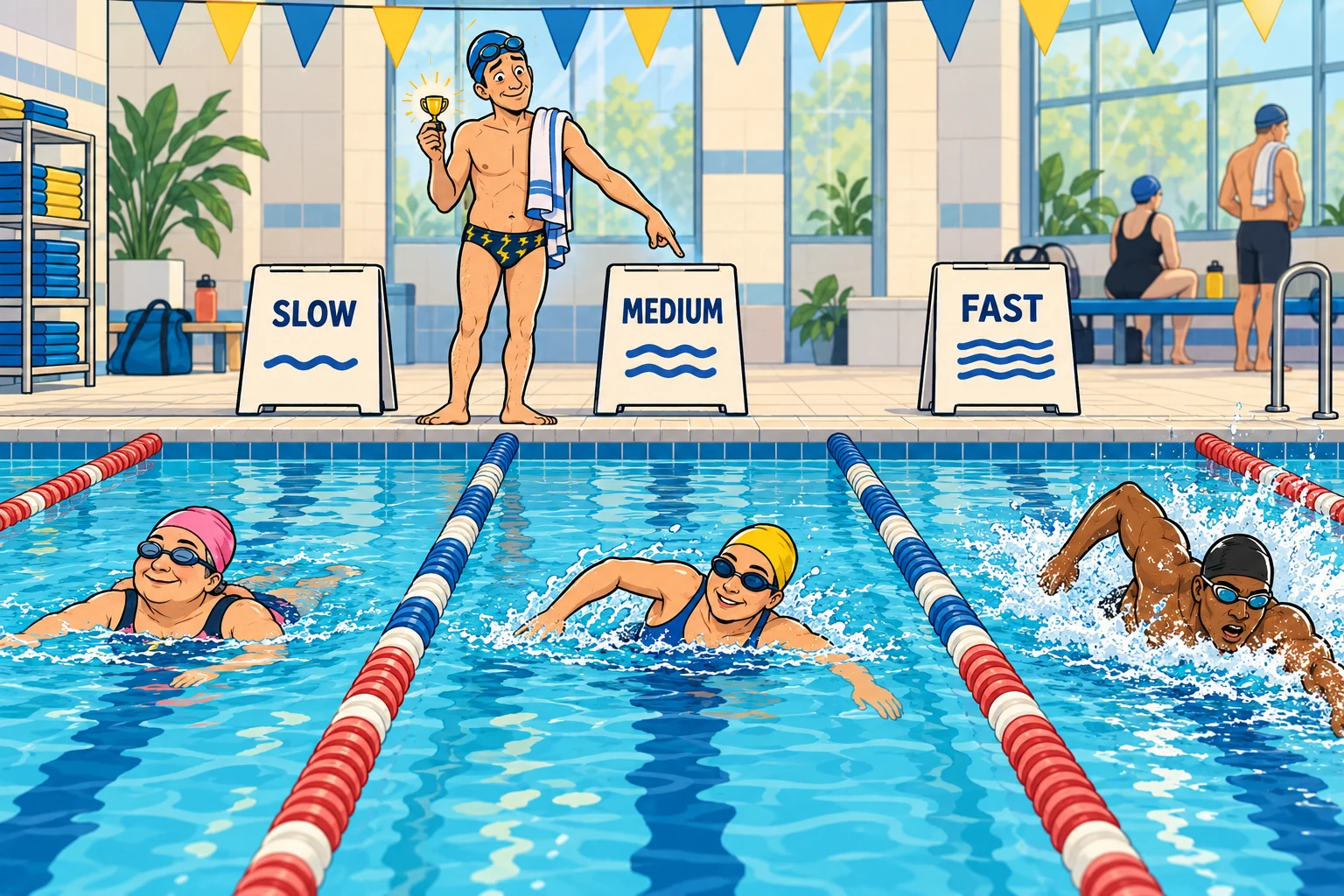
Before you swim
The rule
Many well-organised pools label lanes “Slow”, “Medium”, or “Fast”. Watch a few lengths and choose an open lane where people swim at about your intended speed. You do not need to know your time per length. Check reservations too: a lane marked for lessons is not available, even if it looks empty.
Lane 02
Reserved for lessons
No public swimming
No signs? Watch and ask.
Compare the swimmers instead. For an easy swim, look for a steadier lane rather than one full of fast lengths. If someone is resting at the wall and there is room to talk, try: “Hi, is this a good lane for a steady swim? How are you sharing it?” Wait if they are turning or setting off. Staff can confirm which lanes are open and help you choose.
Why it helps
A similar pace means fewer overtakes and less waiting at the wall, so everyone gets a smoother swim. Your choice can change from one visit to the next: a lane that suits a quick workout may not suit a gentle swim.
At the pool
A realistic example
You usually swim in the fast lane, but today you want an easy swim. Staying there anyway is how you become the Overconfident One: lapped every few lengths and in everyone’s way. After watching a few lengths, you notice the medium lane’s swimmers are moving at the pace you have in mind. You check that it is open and join them.
A little judgment practice
What would you do?
You think of yourself as a fast swimmer, but today you want easy lengths. The fast lane’s swimmers are much quicker than your planned pace; the open medium lane looks like a match. What should you do?
Choose your answer in your head, then open it to check the reasoning.
Join the fast lane. My reputation cannot be seen in Medium.
Reconsider this choice. Choose for the pace you will swim today. A lane label is not a ranking of your ability, and slower lengths in a much quicker lane create repeated overtakes.
Best action: Choose the open medium lane for today’s pace, confirm its pattern, and wait for a clear gap before joining.
Check the medium lane’s swimming pattern and join at a clear gap.
Good judgment. Its current pace matches your planned swim. Checking the pattern and waiting for space helps you join considerately.
Best action: Choose the open medium lane for today’s pace, confirm its pattern, and wait for a clear gap before joining.
Take the empty lane marked “Reserved for lessons”. Empty means available.
Reconsider this choice. A reserved lane is set aside for its stated activity. An empty lane is not necessarily open to public swimming.
Best action: Choose the open medium lane for today’s pace, confirm its pattern, and wait for a clear gap before joining.
Ask for a Very Fast lane. I bought racing goggles.
Reconsider this choice. Equipment does not determine your swimming pace. Watch the swimmers and choose an open lane that suits the session you intend to swim.
Best action: Choose the open medium lane for today’s pace, confirm its pattern, and wait for a clear gap before joining.
Best action: Choose the open medium lane for today’s pace, confirm its pattern, and wait for a clear gap before joining.
Read the lesson and check an answer to enable completion. Any answer counts as practice.
Your Lane Code progress
Progress saving needs JavaScript. Reading and self-check practice work without it.
After reading and trying a practice answer, you can mark a lesson complete. Completion records study, not a pass or proof of swimming ability. Progress stays in this browser on this device; it is not sent to a server. Clearing browser data resets it.
Sources and local variation
- Swim England — Pool etiquette (PDF)
Guidance for pool operators to adapt: lane boards, passing at the end of a length, and turning space.
- U.S. Masters Swimming — Swimming 101: The Basics
Entry awareness, circle swimming and splitting, passing space, and adapting to the current lane. Check local arrangements.
The scenarios are SwimPermit practice examples. These sources inform the draft; a source link is not an endorsement or a completed safety review.
Keep studying
No lessons required before the test. The theory test is being prepared; its introduction is available now.